Most of Abdi Ahmed Farah’s hundreds of goats have died. It has not rained steadily in this part of Somalia for three years, something the 70-year-old never thought possible.
He is in debt from buying water. The reservoir outside his tent is nearly empty. His family is down to one meal a day: rice with sugar and oil. The youngest of his 22 children was born three weeks ago and his wife produces only occasional drops of breast milk.
“I have considered abandoning my family because I cannot provide for them,” said Farah, sitting in front of dwindling food supplies, as if on guard.
Yet another drought is affecting millions of people across Somalia, one of the world’s most vulnerable countries to climate shocks. Some rivers are dry. Crops have withered. Experts say the drought could be among the worst in Somali history.
The crisis is compounded by aid cuts, most dramatically by the Trump administration, and rising prices from the Iran war. Somalia buys most of its fuel from the Middle East, and 70% of its food is imported.
Production of staple crops of maize and sorghum in the October-December rainy season was the lowest on record in Somalia, according to the U.N. Food and Agriculture Organization.
Food security experts warn that nearly a half-million children might face severe acute malnutrition, the harshest kind. That would be higher than the number of children requiring treatment for it during droughts in 2011 and 2022, according to UNICEF.
‘It’s a repeated climate shock’
“2026 is the worst year on record for Somalia in terms of drought,” said Hameed Nuru, the U.N. World Food Program director for Somalia. “Children have started dying.”
The Somali government and United Nations estimate that 6.5 million people face crisis levels of hunger, representing a third of the country’s population and a 25% increase since January.
Aid agencies are trying to maximize resources and the Somali diaspora is sending money to help, but humanitarian workers warn it is not enough.
“This drought is not just another cycle of dry season. It’s a repeated climate shock with shrinking humanitarian support,” said Mohamed Assair, a manager with Save the Children in Puntland, a semi-autonomous region.
People drank dirty rainwater and got sick
Farah once had 680 goats, but a lack of food and water as well as diseases exacerbated by drought have claimed all but 110 of them, barely clinging to life.
“There is no market for my goats because they are so thin. Previously we would trade them for rice, but now we can’t,” he said. Farah’s family has been at a site outside Usgure village for 10 days. Almost a dozen goat carcasses lie nearby.
In Usgure, home to 700 families, community leader Abshir Hirsi Ali said the local economy has collapsed because they rely on pastoralists like Farah. Shops have closed and food rations have run low.
A recent, brief shower brought puddles of dirty rainwater. “Some families were so desperate they drank it … now there is a high number of people with fever,” Ali said.
Save the Children occasionally brings free water to Usgure, but private water trucks have quadrupled their prices and the cost of a 50-kilogram (110-pound) bag of flour has increased by a third, to $40.
“I’m not only afraid for my family but the future of the whole village,” said Muhubo Tahir Omar, a 47-year-old mother of 11 children.
Omar, like other parents, had sold her goats to pay for school fees, “but when we didn’t pay, the teachers left.” Her last goat is now sick.
‘Conflict made our situation even worse’
Decades of conflict in Somalia have displaced millions of people. The drought has displaced another 200,000 this year, the U.N estimates.
Some families flee across harsh landscapes with limited supplies.
“People are on the move … and when people move, people die,” said Kevin Mackey, the Somalia director for humanitarian group World Vision. He recently met people who had walked for nine days to get aid in Dollow in the south.
Around 80 families live in a displacement camp outside Shahda village in Puntland.
Shukri, a 20-year-old mother of four, usually can eke out one meal a day from handouts. Now there is nothing to eat and limited access to clean water.
“The children got diarrhea (from dirty water) and malnourishment worsened,” said Shukri, who gave only her first name. “I know a few people who have died.”
Many people head to Mogadishu, the capital, where food also remains scarce.
Fadumo, a 45-year-old mother of seven, moved there from Lower Shabelle, where livelihoods were already threatened by al-Qaida-linked al-Shabab militants.
“The water sources we depended on for farming, including the river, dried up,” Fadumo said. “Conflict made our situation even worse, forcing us to flee.”
‘The outlook is deeply concerning’
Drought ravaged Somalia in 2022 and an estimated 36,000 people died, according to the U.N. Now the kind of aid that was rushed to respond to such crises is shrinking.
“Unless there is a sudden and substantial response from donors, the outlook is deeply concerning. A drought of similar severity in 2022 received a response five times greater than what we are seeing,” said Antoine Grand, head of the International Committee of the Red Cross in Somalia.
Aid funding to Somalia dropped to $531 million in 2025 in large part because of aid cuts by the United States, which had been Somalia’s top donor. In 2022, aid funding was nearly five times as much at $2.38 billion.
WFP said it intended to help 2 million people with food aid this year but has reached only 300,000 because of funding gaps.
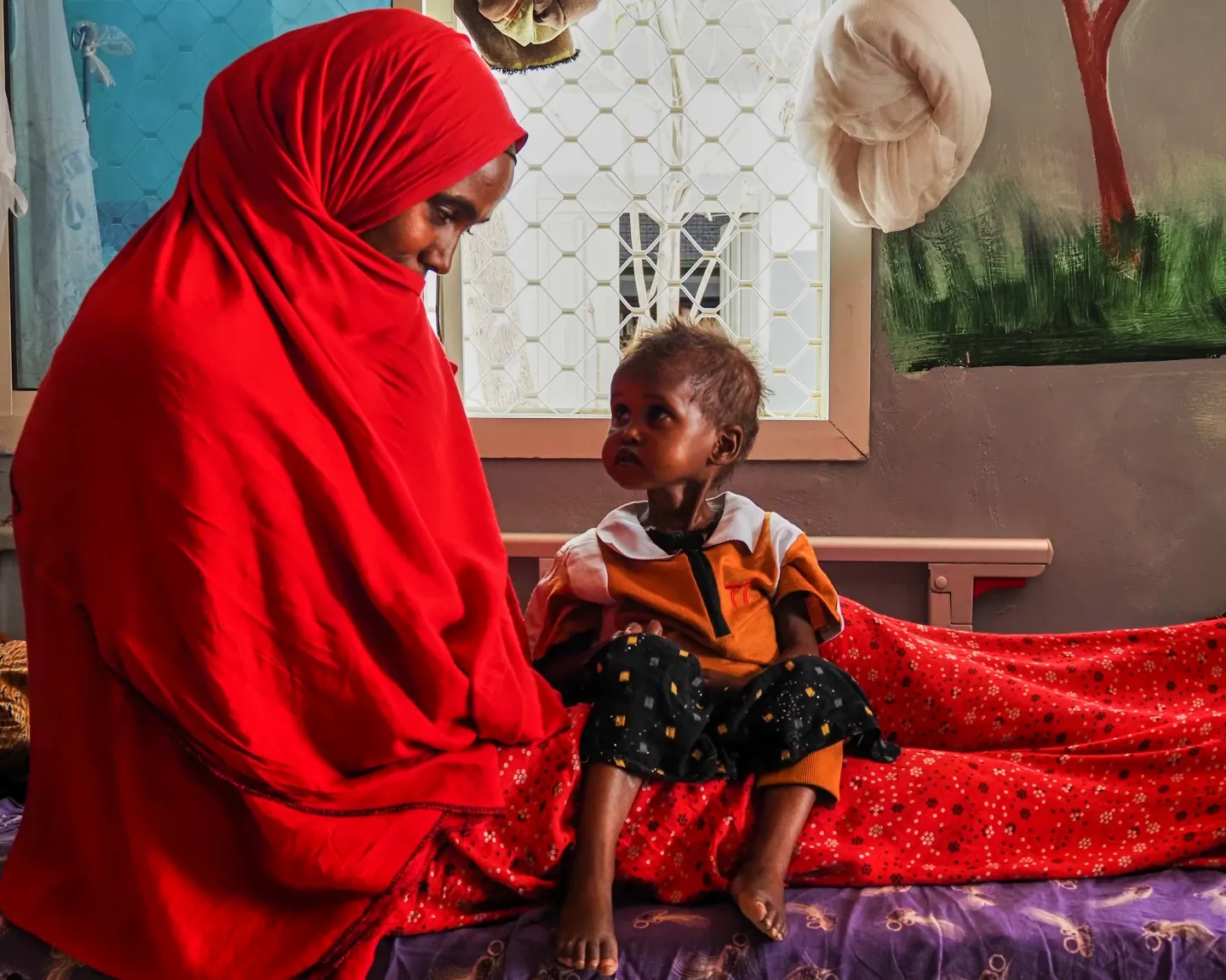
A center at the hospital in Qardho, Puntland, treats children with severe acute malnutrition. But therapeutic milk is now rarely in stock, and nurses resort to homemade alternatives such as cow’s milk, said director Shamis Abdirahman.
The center receives around 15 children a month, but they expect more as displaced people arrive.
One 4-year-old, Farhia, weighs a scant 7.5 kilograms (16.5 pounds). Her eyes are sunken and her bones are prominent under her skin.
Her family fled to Qardho when all of their goats died, said her mother, Najma.
“I don’t know what to hope for, or see how we can get back to what we had,” she said.
The Associated Press receives financial support for global health and development coverage in Africa from the Gates Foundation. The AP is solely responsible for all content. Find AP’s standards for working with philanthropies, a list of supporters and funded coverage areas at AP.org.