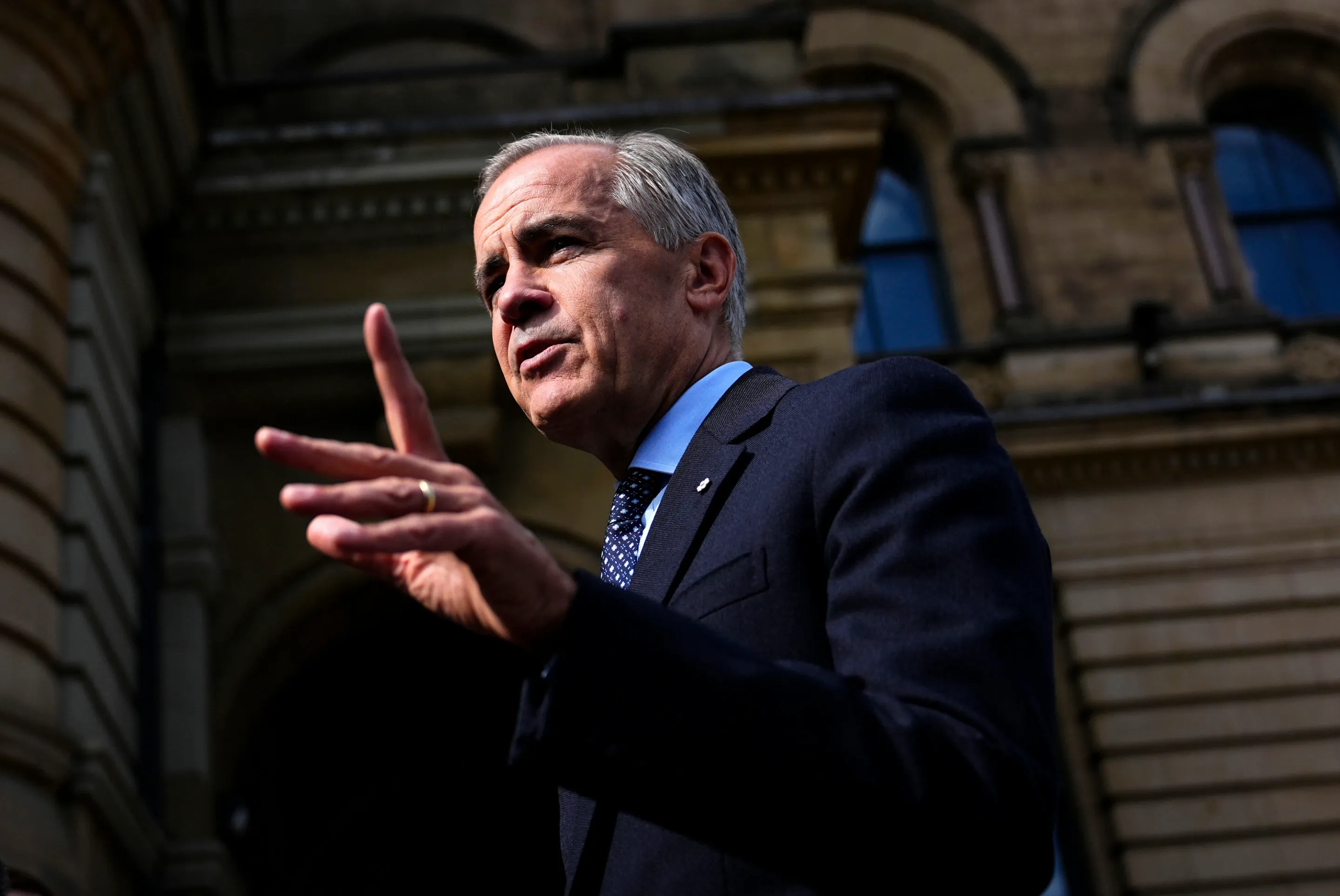
Canada retaliated against U.S. President Donald Trump on Tuesday by imposing tariffs on approximately $20 billion worth of American goods, following recent rounds of tariffs targeting Canada.
The situation may have implications beyond Canada, testing whether a smaller U.S. ally can withstand economic pressure from Trump's administration.
Canadian Prime Minister Mark Carney stated that U.S. demands could undermine vital Canadian industries and restrict the nation’s autonomy, while Trump’s threats to Canadian sovereignty have galvanized public support for him.
"Carney and Canada have become symbolic of resistance to him," noted Canadian historian Robert Bothwell. "And what he’ll want to do is make an example of Carney and Canada and theoretically terrify everybody else while in fact showing them that they need to remove themselves even further from the United States."
The tariffs affected hundreds of American products, including steel, aluminum, cheese, appliances, clothing, cosmetics, and farm equipment, with rates set at 15%, 25%, or 50%.
Canada Retaliates With Tariffs on Hundreds of US Products
Canada asserted that its tariffs mirror Washington's actions dollar for dollar and rate for rate. These measures took effect at 12:01 a.m. Tuesday under an executive action termed an order in council, covering about $20 billion in American goods, which represents roughly 6% of the $333.6 billion the United States exported to Canada last year.
RBC Economics, the research division of the Royal Bank of Canada, indicated that these measures are unlikely to significantly impact overall U.S. growth but could severely affect certain businesses.
Canada has taken actions beyond tariffs previously. Eight of its ten provinces maintain restrictions or bans on the sale of U.S. alcohol. The Distilled Spirits Council reported that U.S. spirits exports to Canada declined by over 70% year-over-year after these restrictions were implemented.
Trump Threatens Further Punishment for Canada
Since trade discussions between Canada and the U.S. ended on August 21, Trump and his administration have issued numerous tariffs, threats, and personal attacks characterizing Canada as weak and dependent.
On Monday, Trump threatened to prohibit the sale of aircraft from Bombardier unless they began manufacturing planes in the United States.
"NO MORE SELLING BOMBARDIER IN THE UNITED STATES! Their products aren’t good enough!" Trump posted on Truth Social. "If they want our Market, they must build here, and stop treating America like a ‘piggybank.’"
Flavio Volpe, president of APMA Canada, a manufacturing trade group, responded on X that Bombardier utilizes U.S.-made GE and Honeywell jet engines and employs around 3,000 U.S. workers.
Trump had previously warned that the Canadian economy could collapse if Carney continued to treat him as "the enemy," threatening consequences "worse than anything that has ever happened to a Canadian Politician."
U.S. Trade Representative Jamieson Greer has threatened that Washington might outright ban certain Canadian goods in response.
Trump even renamed Lake Ontario "Lake America," a change that was ignored and mocked in Canada. Google and Apple yielded to Trump's pressure by altering their maps for U.S. users. On Monday, he posted a social media map of North America covered with the U.S. flag.
"After renaming a gulf and a lake, maybe the next step for him is to rename a river?" commented Daniel Béland, a political scientist at McGill University.
Trump's Pressure Hardens Resistance in Canada
Trump’s trade war rhetoric and repeated suggestions of making Canada the 51st state have increased anger and bolstered support for Carney. Canadians have significantly reduced travel to the United States and boycotted U.S. products.
The current trade conflict began after Trump returned to office and imposed tariffs on Canadian goods, despite having negotiated and repeatedly praised the North American trade agreement during his first term. Many of these tariffs violate that pact.
The breakdown is particularly notable given the long-standing close relationship between the two countries, characterized by deeply integrated economies, strong defense and security cooperation, extensive cultural ties, and, prior to relations deteriorating, approximately 400,000 people crossing the border daily.
Carney has stated that talks could resume when Americans "stop doing memes, stop throwing shade, stop trying to be tough" and adopt a serious approach.
Thus far, Trump’s pressure has had the opposite effect in Canada, strengthening support for Carney rather than compelling concessions.
Nelson Wiseman, professor emeritus of political science at the University of Toronto, observed that Trump's 2024 reelection deepened Canadians' mistrust of the United States—not only its government but also American judgment.
"Canada-U.S. relations, even without confrontation, will never be what they were before Trump," he stated.
Carney Becomes a Global Voice Against Trump
At the World Economic Forum in Davos in January, Carney cautioned that powerful nations are employing economic integration to coerce smaller countries. This speech helped position him as a leading voice among nations seeking ways to resist Trump.
Trump responded one day later by asserting Canada "lives because of the United States" and warning, "Mark, remember that next time you make your statements."
Carney is scheduled to address the European Parliament next week, providing him with another significant platform.
"The Canadian public is behind the Carney government and the world is watching what will happen next," said Béland, the McGill political scientist. If Canada's defiant stance proves successful, he added, it "could be used as a template" for resisting the Trump administration’s trade policies.
The dispute also centers on whether Canada can maintain its manufacturing base.
Trump has also threatened 50% tariffs on Canadian vehicles, auto parts, and steel next year if Canada does not "fall in line," which could represent a devastating escalation for industries reliant on deeply integrated North American supply chains.
"We want the cars to be made in Detroit and in South Carolina and in Tennessee and in all of our places where we make cars. We don’t want them to be made in Canada," Trump said.
A 50% auto tariff could severely impact Canadian plants and increase vehicle prices across North America because parts and finished vehicles frequently cross the border during production.
Carney contends that Washington's conditions could lead to Canadian industries being "gradually wound down in Canada and wiped out."
Could Canada Succeed?
Canada begins from a disadvantage: The U.S. economy is roughly 13 times larger, and Canada sends over 70% of its exports south of the border.
However, Béland noted that this is not a typical trade dispute. He pointed to Trump's domestic unpopularity, the approaching midterms, and potential court challenges that could overturn more U.S. tariffs.
"Under normal conditions, this would be a very long shot for Canada," he said.
But Washington also has vulnerabilities. U.S. refineries depend on 4 million barrels of oil daily from Canada, and American farmers rely heavily on Canadian potash fertilizer. To date, however, Canadian leaders have refrained from leveraging some of that influence by taxing or restricting critical exports.
Canada entered this phase with some economic momentum. Its economy grew at a 3.2% annualized rate in the second quarter, more than double the 1.5% pace seen in the United States.
Industry Minister Mélanie Joly clearly articulated the government's objective:
"I’m convinced that we will be able to show the world that Canada will win this trade war."