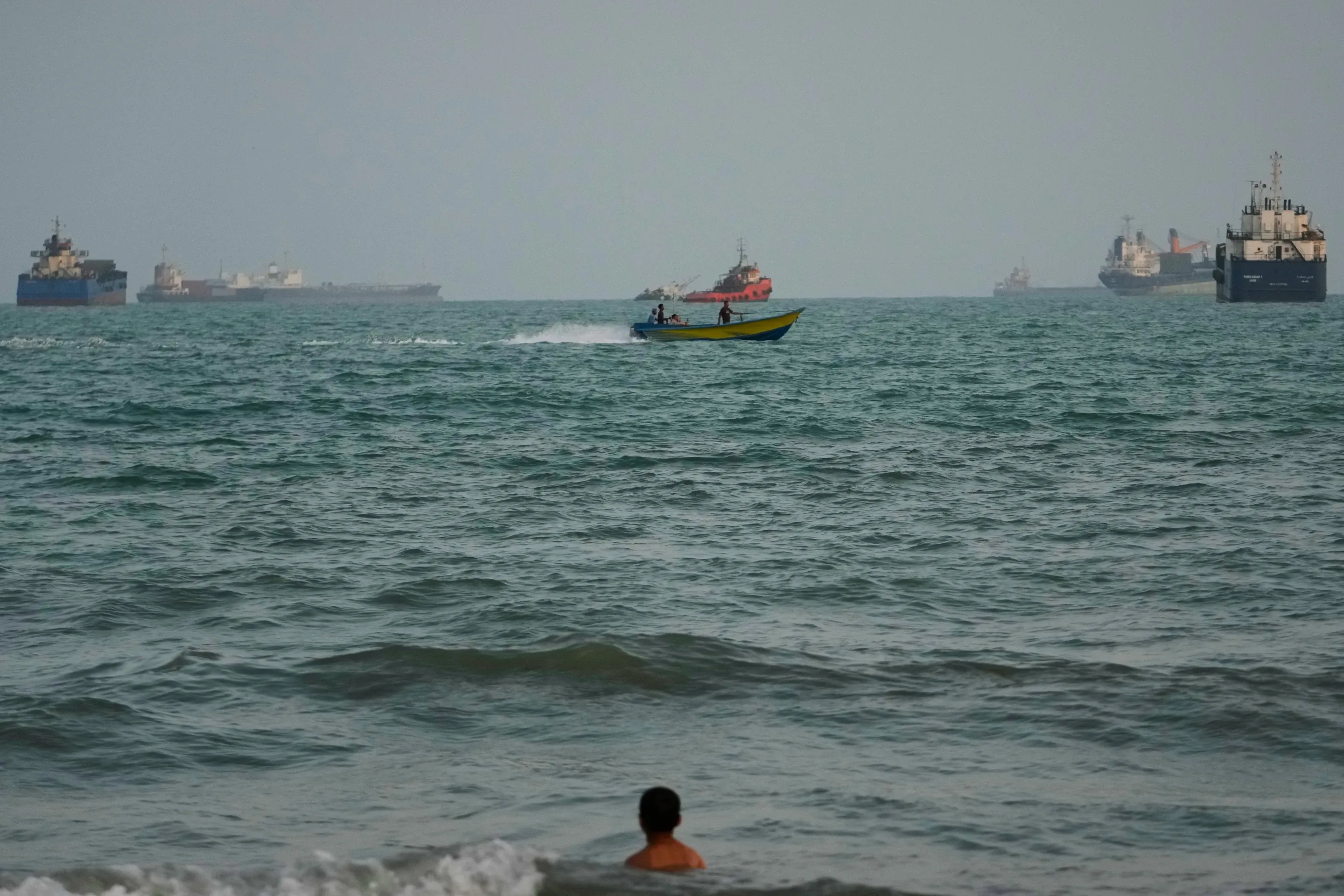
The U.S. military stated Saturday that American forces hit three Iranian oil tankers after U.S. Navy warships were targeted with missiles, while warning it would "if necessary, destroy Iran’s limited and exposed oil fleet."
These strikes occur a day after U.S. President Donald Trump characterized the conflict as "small potatoes" in an effort to minimize tensions. This action marks a renewed escalation toward fighting after six months of intermittent conflict that began with attacks by the U.S. and Israel on February 28. Both nations have aimed to inflict military and economic damage, but negotiations have stalled.
The military's statement reported that an American aircraft carrier and a destroyer successfully evaded "multiple unprovoked Iranian attacks" during patrols in the region without any U.S. personnel being injured. It further detailed that two Iranian oil carriers were "permanently disabled," and a third, which was unladen, was destroyed.
The U.S. statement asserted that these tankers were part of an unofficial network used to finance Iran’s Revolutionary Guard and its armed proxies in the region.
Iran issued no immediate response.
Earlier, Iranian state television had claimed that four U.S. missiles struck a tanker located approximately 6 miles (10 kilometers) from Kharg Island, which hosts a terminal vital for the country's oil exports. Kharg Island has been subjected to repeated targeting during the conflict, including prior U.S. strikes on military installations there in March.
The U.S. specified that one tanker was struck off Kharg Island and another near Jask, east of the Strait of Hormuz. The unladen tanker was hit in the Gulf of Oman, and the U.S. reported its crew had been "directed to abandon ship." The statement included video footage it described as showing the strikes.
Adm. Brad Cooper, head of U.S. Central Command, stated, “We will not hesitate to defend American forces, and if necessary, destroy Iran’s limited and exposed oil fleet.”
The strikes occurred nearly a week after the U.S. and Iran resumed attacks following a period of relative calm, leading to renewed targeting of Iranian communities along the Strait of Hormuz. Earlier in the week, at least five people were killed during a U.S. bombardment of southern Iran; one strike impacted a wedding celebration.
Masoumeh Zarei, 13, sustained injuries in the attack and spoke to The Associated Press from a hospital where she was receiving treatment for abdominal wounds. She recounted that the wedding had begun when she left to attend but she never arrived, having been knocked unconscious when a telecommunications tower was struck. Her memory returned later while hospitalized.
Zarei told reporters, “The party had just started, and we wanted to go there. I had made my nails really pretty for the party, but everything changed,” her voice hoarse.
Her friend, 14-year-old Kiana Karimi, was also wounded and remains in intensive care. Karimi informed the AP that she heard five explosions. “The first three explosions at the telecommunications tower threw us to the ground,” Karimi said. “I quickly got up to pick my brothers up off the ground. Then there were two more explosions, and after that I don’t remember anything.”
U.S. Efforts Focused on Economic Pressure
The recent resumption of fighting followed new U.S. attempts to apply economic pressure on Tehran, whose newly appointed hard-line senior leaders have indicated a readiness to persist despite decades of sanctions. However, the elected government under Iranian President Masoud Pezeshkian has expressed preference for a negotiated resolution to the war.
Iran has developed methods over the years to bypass sanctions—and currently a U.S. blockade of its ports—to move oil to buyers and mitigate increasing economic strain. This process is partially dependent on a shadow fleet transporting its oil.
Meanwhile, the issue that initially contributed to the conflict—Iran’s nuclear program—was intended to be addressed in negotiations that collapsed shortly after the U.S. and Iran signed a memorandum of understanding in mid-June. Instead, Tehran's current leverage centers on the strait critical for global oil and natural gas shipments, which was previously considered an international waterway before the war began.
The U.S. military has been assisting with guiding ships through the strait as Tehran asserts control and targets certain vessels, though overall traffic remains low.