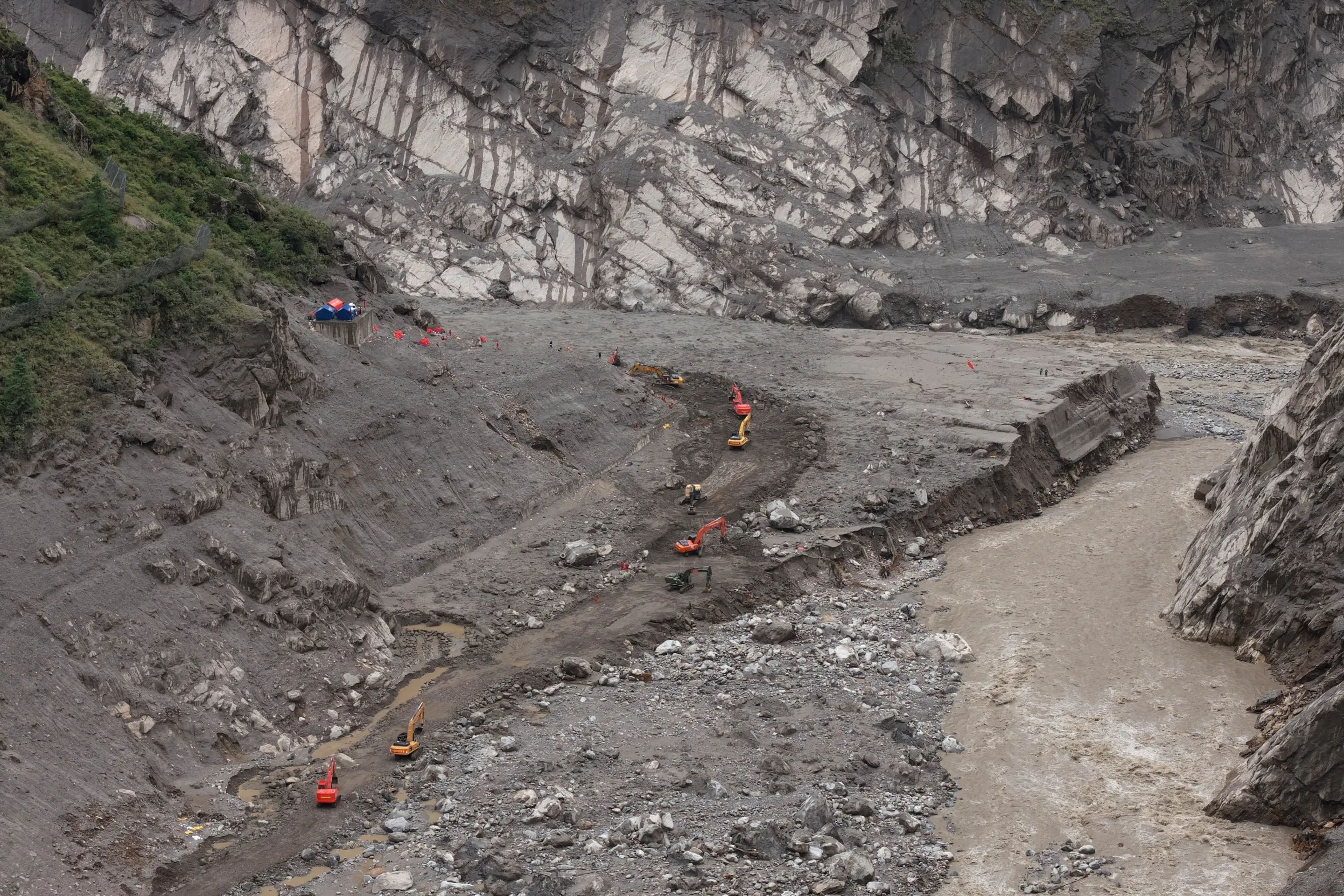
More than a week after deadly flash floods killed hundreds and left thousands missing near the China-Nepal border, very little information is available regarding the victims on the Chinese side.
The disaster, which has resulted in over 1,000 deaths and more than 4,500 people missing across both nations, has once again highlighted China's stringent control over information concerning disasters and its efforts to manage public discourse about them.
Death toll updates occur only every few days, and access to the disaster zone has been restricted solely to top-level state media outlets. These outlets have avoided broadcasting the names or faces of missing individuals or their relatives, instead favoring videos depicting aid logistics or rescue dogs at work.
Concurrently, at least 10 people throughout China have faced detention or fines for social media posts that questioned elements of the official narrative.
This contrasts sharply with the Nepalese side of the border, where officials provide regular updates on deceased and missing persons, while journalists and social media platforms document the unfolding disaster and recovery operations.
Grieving families have been able to gain visibility, providing voice and context to those lost as people conducted symbolic burial rites or traveled independently in search of loved ones.
China last revised its figures late Wednesday, stating that 21 individuals had died and 541 were missing in Tibet, including 261 foreigners from 23 countries.
Nepal Allows Close Reporting in Affected Areas
The Nepalese government has issued continuous updates on rescue efforts, which includes a website listing those who have been rescued. The army has released footage of helicopter rescues and people being pulled from hydropower tunnels covered in mud.
Nepal shares near-daily updates regarding rescued individuals and permits both domestic and foreign journalists to report from the area.
Journalists have managed to visit disaster sites. Although the Nepalese government imposed certain restrictions, such as requiring accreditation, reporters were ultimately permitted to cover events at government locations like aid camps where survivors are temporarily housed, and visit mass burial grounds.
Access to China's Disaster Zone is Restricted to State Media
Conversely, access within China has been limited for all but a small number of journalists affiliated with state media outlets.
The Associated Press requested entry to the affected regions shortly after the disaster struck but has not received permission to visit.
China frequently endeavors to manage information related to disasters, but in the tightly controlled region of Tibet, the flow of information has been particularly restricted.
Tibet is a Chinese autonomous region that has experienced cycles of protest, unrest, and government repression since China assumed control in 1951. Currently, the region is the subject of significant central government investment and poverty alleviation initiatives. Communications are also heavily monitored and limited, making it difficult for Tibetans to communicate freely with people outside China. All foreigners, especially journalists, require special government permission to travel to Tibet, even if they hold full accreditation to work in China.
Media access to the rescue sites has been reserved for Xinhua News and CCTV, China's two primary state media organizations. CCTV has concentrated on the official response, emphasizing President Xi Jinping’s directives for disaster relief and sharing reports highlighting heroic actions, such as rescuers being airlifted by drone, hanging by rope, or police comforting a bereaved family member. Xinhua News has issued formal disaster reports alongside technical dispatches detailing glacial lake science.
Meanwhile, Human Rights Watch reports that some Chinese journalists have received instructions not to interview relatives of the deceased or missing and to rely exclusively on material from Xinhua.
China Punishes Individuals Questioning Official Death Toll
Furthermore, China has publicized its actions against individuals who expressed doubts about official accounts.
State media widely circulated a report from the Tibetan Cyberpolice detailing 10 cases where police across China penalized people for "spreading rumors online" regarding the disaster.
This could encompass questioning the official death toll, as seen in one post stating: “It’s clear that at least 1,000 people were washed away, yet the official report only says three people dead and 265 missing.”
Penalties ranged from five to 10 days of police detention, with a $150 fine applied in some instances.
China is often slow to release complete data on major disaster fatalities. For instance, after a typhoon caused severe flooding in Guangxi's Southwestern province in early July, the government updated the official death toll figure over a month later, increasing it from 39 dead to 159.
The government has revised the reported flood death toll multiple times, most recently setting it at 21 on Wednesday.
Families of Some Missing Persons Share Voices Through Overseas Outlets
Relatives of a few missing individuals have spoken publicly through rare channels operating outside direct Chinese control.
Aquarian, an independent Chinese media outlet based in exile, interviewed families of missing Chinese victims, including Peng Guangming, who worked on a highway project supported by China on the Nepal side of the border. Peng was last confirmed to be in contact with a colleague about 10 minutes before the flood.
Another missing person is identified as He Hongrong, according to the X account Fat Parrot, which shares Chinese social media posts onto X. The X user declined an interview but stated they had been in contact with He’s family and a friend.
She was last seen on the Nepal side of the border carrying a green backpack, waiting to return into China last Wednesday morning. She had hired a driver for transport back to Lhasa, Tibet. Her family hopes that by posting her photo on X, someone will provide information about her location.