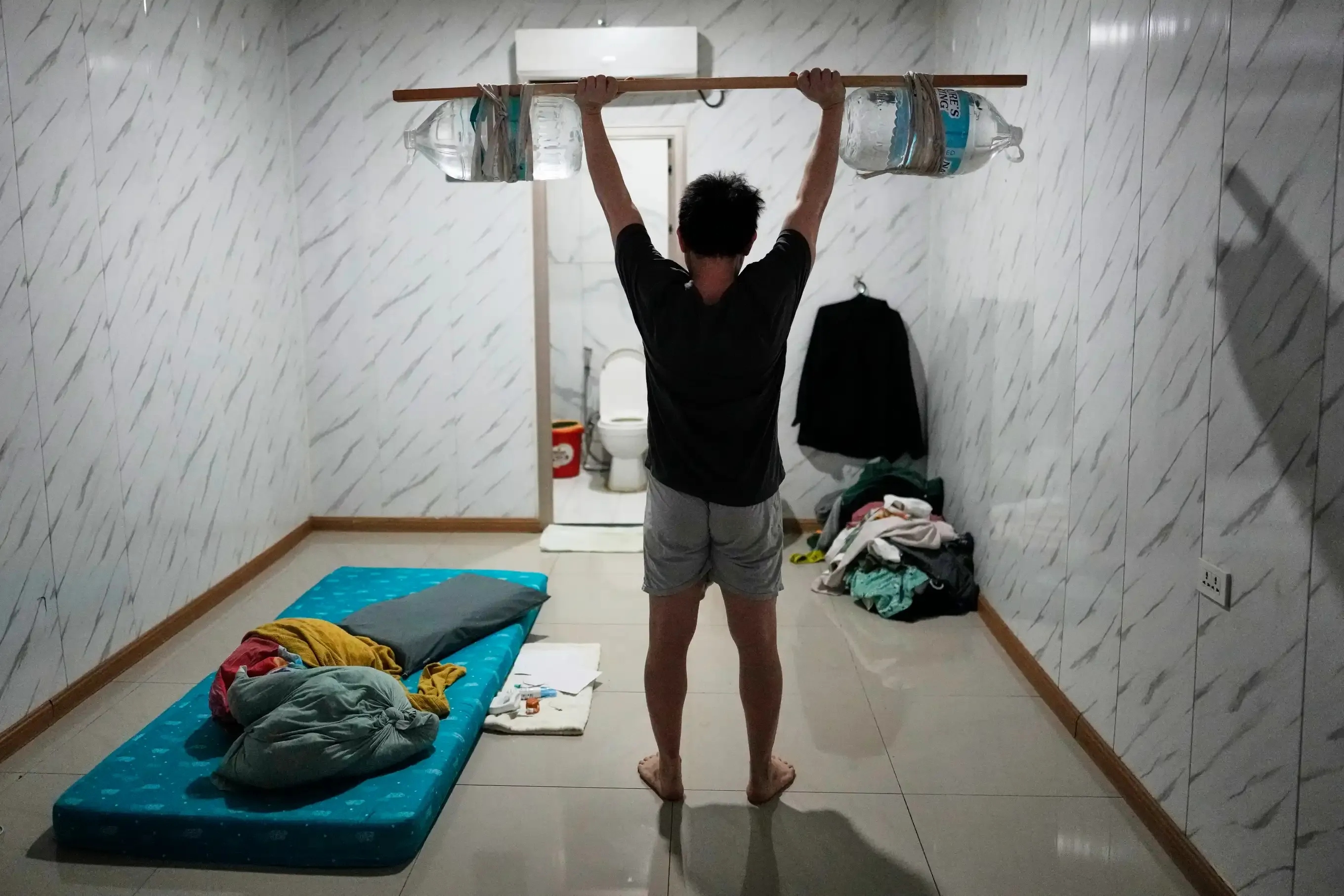
He had lost count of the number of times he was sold from company to company in the Philippines.
Wind said that after a relative lured him from his village in southern China for an office job, he quickly realized the advertised work was false. Instead of administrative duties in Manila earning 10,000 yuan ($1,500) monthly as promised, he was forced to scam people and paid only around $50.
When he failed at scamming, he was sold, according to him. For several years until Filipino police raided his company, he remained trapped in a cycle of underperforming in scams, being beaten, and then being sold. He stated he was sold at least half a dozen times, with prices ranging from a few thousand dollars up to 2.1 million pesos ($34,000).
“I regret it, but there’s no point in regret,” he said about his experience.
Wind is one of many scam workers involved in the industrial-scale cyberscam operations that have emerged in Southeast Asia recently, spanning from the Philippines to Cambodia. These operations sometimes require workers to sit before a computer for up to 16 hours daily to execute complex online scams. The Office of the United Nations High Commissioner for Human Rights estimates that over 300,000 individuals from 66 countries constitute this workforce.
Philippines President Ferdinand Marcos Jr. issued an order in July 2024 banning all scam operations, many disguised as online gambling businesses, initiating a nationwide crackdown. Initial raids resulted in the rescue of numerous workers, but the criminal groups subsequently fragmented into smaller operations that are now more difficult to detect.
Wind, who was interviewed last year, was rescued along with 400 other foreign workers from the notorious Bamban scam compound raided in March 2024. This compound was partly established by former Philippines mayor Alice Guo, who has since been sentenced to life in prison for human trafficking. He used a pseudonym because he was part of the condition for interviewing someone under witness protection for Philippine authorities prosecuting these cases.
Today, he is still awaiting his return home from the Nasdake building, which was seized by the Presidential Anti-Organized Crime Commission (PAOCC) in 2023.
Many individuals staying in the Nasdake building originated from the region, such as Vietnam, China, and Malaysia, but one man came from as far away as Madagascar. Some were trafficked, while others arrived voluntarily hoping to earn money.
Jade, another witness from China who agreed to speak under terms similar to Wind's, reported being beaten multiple times. He recounted that one instance was so severe he required dental work afterward due to the pain.
“I was beaten because I didn’t want to scam,” he stated during an interview last year.
Violence is a characteristic of this industry, used to compel its workers.
Office spaces occupy much of the floor area inside the Nasdake building, which is a six-story former scam compound converted into a temporary detention facility by the Philippine government. Other areas include a mini karaoke lounge and a massage section with private suites.
However, authorities showed the AP during a tour that the entertainment rooms and luxurious areas where bosses and senior managers were accommodated are on the same floor as a sparse room featuring a single metal bar where torture occurred. At its peak, the detention facility held over 900 people, the PAOCC reported. The numbers fluctuate based on repatriation efforts; currently, the center houses about 70 people.
The complex is managed jointly by the Department of Justice and the Bureau of Jail Management. Workers are mostly confined to their rooms, where four to six individuals are packed into wooden bunk beds. Others sleep on mattresses placed on the floor in a large open area divided into small sections.
Many are simply waiting for a return ticket from their respective governments, staying anywhere from a few weeks to months or years. Wind, who testified, was among the few willing to be interviewed. He was rescued from the infamous Baofu scam compound linked to former mayor Guo, who still faces money laundering charges.
At Baofu, located 1.5 hours outside Manila, officials counted approximately 36 buildings during the raid, consisting mostly of small stand-alone villas and a few larger dormitories. The complex, which overlooks Bamban city hall, combined luxury with utility, featuring a swimming pool and Chinese restaurants alongside worker bunk beds.
After his rescue from the Baofu compound, Wind said his experience had changed him. “I don’t feel like there’s anyone you can trust. Everyone’s out to cheat you.”