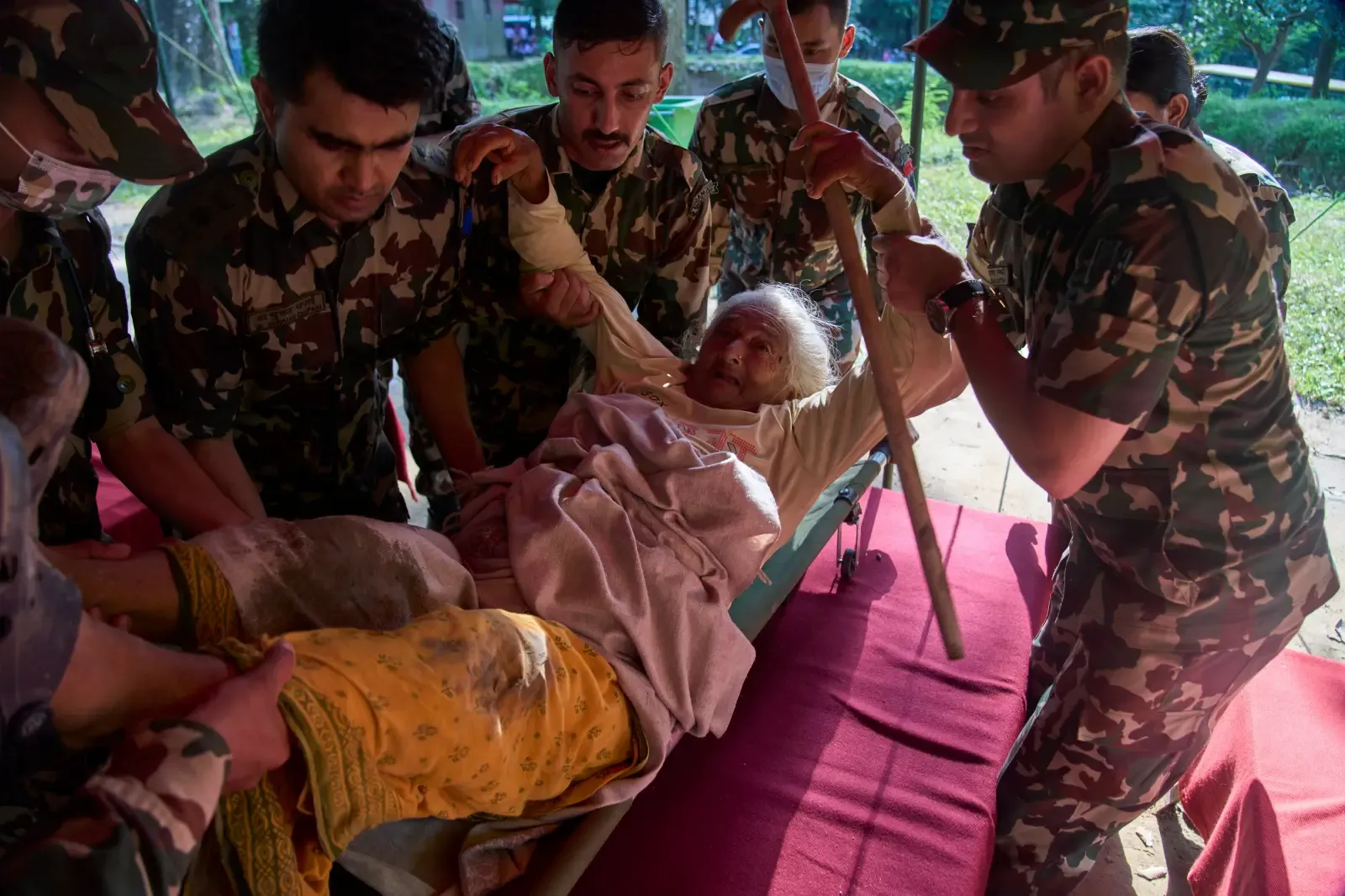
Rescuers worked through mud and debris Friday in areas devastated by a catastrophic flash flood along the Himalayan border between Nepal and China, continuing the search for hundreds of people still missing as the death toll rose and authorities warned that a newly formed, overflowing lake could trigger further flooding.
Nepal police reported on Friday morning that the country’s death toll had increased to 469 from 390 the previous day, as rescuers recovered more bodies amidst the debris. China has not updated its report of only three deaths in Tibet. Collectively, the two nations have stated that over 1,500 people are missing.
Nepali and Chinese authorities issued warnings regarding additional flooding stemming from a lake that formed upstream after Wednesday’s disaster and was already overflowing. They urged residents in potentially affected zones to relocate to safer ground. China’s Ministry of Water Resources announced on Thursday that the lake contained approximately 2 million cubic meters (70 million cubic feet) of water and was projected to gain another 3 million cubic meters (106 million cubic feet) over the next three days.
Chinese state broadcaster CCTV reported Friday morning that the lake's barrier was more than 10 kilometers (6 miles) from Gyirong Port, the border crossing with Nepal that was submerged by mud and floodwater.
CCTV stated that the lake is situated at an elevation of 2,950 meters (9,680 feet), roughly 1,000 meters (3,280 feet) above Gyirong Port.
The Nepal Army confirmed that a team was dispatched to the border point to inspect the Bhotekoshi River due to the potential for more flooding.
Thousands of people have been evacuated
Nepal’s National Disaster Risk Reduction and Management Authority reported on Friday that 3,253 individuals had been airlifted by helicopter from the disaster area in Nepal.
Flood survivors, including injured persons, were transported to Kathmandu and other locations. Foreigners from various countries were among those listed as missing, many of whom were trekkers or pilgrims.
Nepali Army spokesperson Brig. Gen. Raja Ram Basnet informed The Associated Press that a team was deployed Friday to the Upper Trishuli-1 Hydropower Project near the Nepal-China border following reports of people trapped inside a tunnel.
“It is complicated to find the entry and exit points of the tunnel because everything has been covered by mud,” Basnet stated. “Our first priority is rescuing the stranded people.”
Videos from the disaster showed floodwaters destroying buildings, bridges, and vehicles as people ran before the stories-high torrent. Afterward, broken concrete was seen upended in vast expanses of brown mud that also coated buildings and buried streets.
Some individuals reported feeling the ground shake, followed by observing a ‘black storm.’
Customs officer Karbir Gaire is among some survivors in Timure, the Nepalese village closest to the China border.
Gaire arrived at his office around 8 a.m. on Wednesday and was working on his computer when he first felt the ground tremble.
“Right after the shake, I noticed a black storm coming towards us,” he recalled from Kathmandu, where he is now with family. “We all immediately started running out, and within a few seconds, we were climbing uphill on the opposite side of our office building. I think those 10 or so seconds saved some of us.”
Gaire could not recall the exact number of people in the office when the disaster occurred, but his 15 colleagues are missing. “It was like a Hollywood movie scene. I don’t call it a flood, it was a tsunami.”
He described Timure as a lively area containing government offices, hotels, cafes, banks, primary schools, tea shops, and residential buildings, where over 1,500 people resided.
Families worldwide are receiving news about missing loved ones.
Rajan Tamang, a restaurant owner in New York City, said he learned from family in Kathmandu that his mother and sister were among those who died, while many other relatives and friends remain missing.
“My family was just waking up, and they didn’t even get any information, and suddenly this flood came. Some of them are missing, some of them lost their life and only a few is alive,” he told The Associated Press after attending a vigil in New York.
Vishnuram Ramaswamy works for a private company in Puducherry, southern India, and said he last spoke to his mother and two sisters who were on pilgrimage to Mount Kailash on Wednesday morning at 9 a.m.
“My mother said they were on their way towards the border area and said they’ll reach their hotel and call us,” he said. “This was the last we spoke to them. They have been unreachable since.”
Ramaswamy stated that he maintains constant contact with officials from Nepal and India, as well as the travel agencies that arranged his family's trip, but has not received any updates on their whereabouts yet.
“This was the first time they had gone on this pilgrimage and it was something my mother always wanted to do,” he added.
Some of the missing individuals may have been on a pilgrimage to Mount Kailash in Tibet, a sacred site for Hindus, Buddhists, and others.
According to an X post from Indian spiritual guru Jaggi Vasudev, also known as Sadhguru, seventy-seven people from one pilgrimage group were caught in the floods at the immigration office at the border.
Nepal’s tourism board has reported that over 500 foreigners are among those missing.
U.S. President Donald Trump commented on the flooding, describing it as terrible to witness and noting how “strong, well-built buildings were wiped out like they were toothpicks.”
Speaking to reporters in the Oval Office, Trump said the U.S. had communicated with Nepalese leaders and offered to provide “anything they want.”
Scientists who analyzed satellite imagery indicated that bedrock beneath a glacier high in the Himalayan region had collapsed, taking part of the glacier with it. The resulting rocks and melted water swelled the rivers in the valleys below, generating a torrent of water that swept buildings, bridges, and earth downstream.
Associated Press journalists Eileen Ng in Kuala Lumpur, Malaysia; Sibi Arasu in Bengaluru, India; Upendra Mansingh in Nuwakot District, Nepal; Aijaz Hussain in Srinagar, India; Rod McGuirk in Melbourne, Australia; Ali Swenson and Edith Lederer in New York; Matthew Lee, Collin Binkley and Fu Ting in Washington, and Hannah Schoenbaum in Utah contributed to this report.