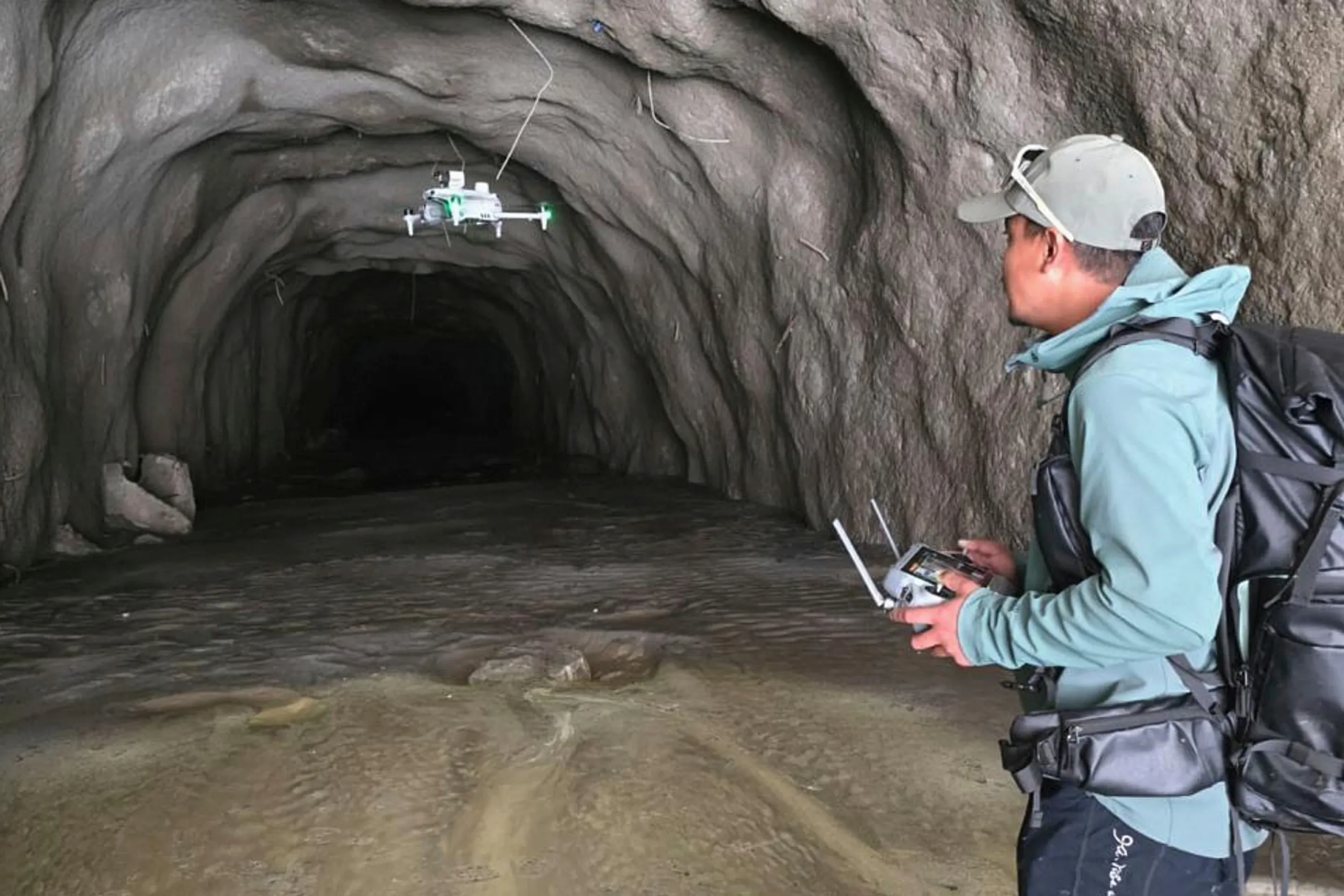
Drone pilot Manish Maharjan assisted rescue teams in locating missing individuals following last week's severe floods, sometimes employing speakers on the drones to call out or play music for those stranded on hillsides.
However, he noted that searching for hundreds of workers thought to be trapped in power plant tunnels—a primary focus of current rescue operations—presents a completely different difficulty.
“We found tunnels were filled with mud like toothpaste in a tube,” Maharjan stated. “There was no hollow or empty space inside.”
Maharjan, who is also a filmmaker, joined the Nepal Army’s relief efforts one day after the August 26 flash floods, which have resulted in over 1,000 deaths and left thousands missing across Nepal and Tibet.
“We used microphone speakers to call out to them. In some places, we even played songs and then waited for a response,” Maharjan said. “That worked in a few cases and helped us locate people.”
The massive influx of water following a glacial collapse in the Himalayan region caused extensive damage to vital infrastructure, including roads, buildings, bridges, and hydropower plants. At least 900 workers remain missing from 12 hydropower projects buried under mud and debris. Approximately 500 of these are believed to be trapped within power plant tunnels.
According to Mohan Kumar Dangi, president of the Independent Power Producers’ Association, some workers in the tunnels managed to signal for help when the disaster occurred. However, it remains uncertain whether rescuers have made contact with those trapped since the initial distress calls.
As time passes, locating these missing people is becoming increasingly difficult for rescuers.
Maharjan, who has been utilizing thermal drones inside the tunnels, explained that searches are challenging due to restricted access and the complete lack of open space.
“I can only fly drones in tunnels that are long and straight,” he said. “Once there are bends, turns or zigzags, it becomes much harder to operate and search effectively.”
At the Rasuwagadhi hydropower project on Monday, Maharjan successfully sent a drone deep into and to the end of a tunnel but found no sign of life.
“We checked repeatedly but it was filled with mud and debris,” he said. “Looking at it, I could only imagine the force of the flood.”