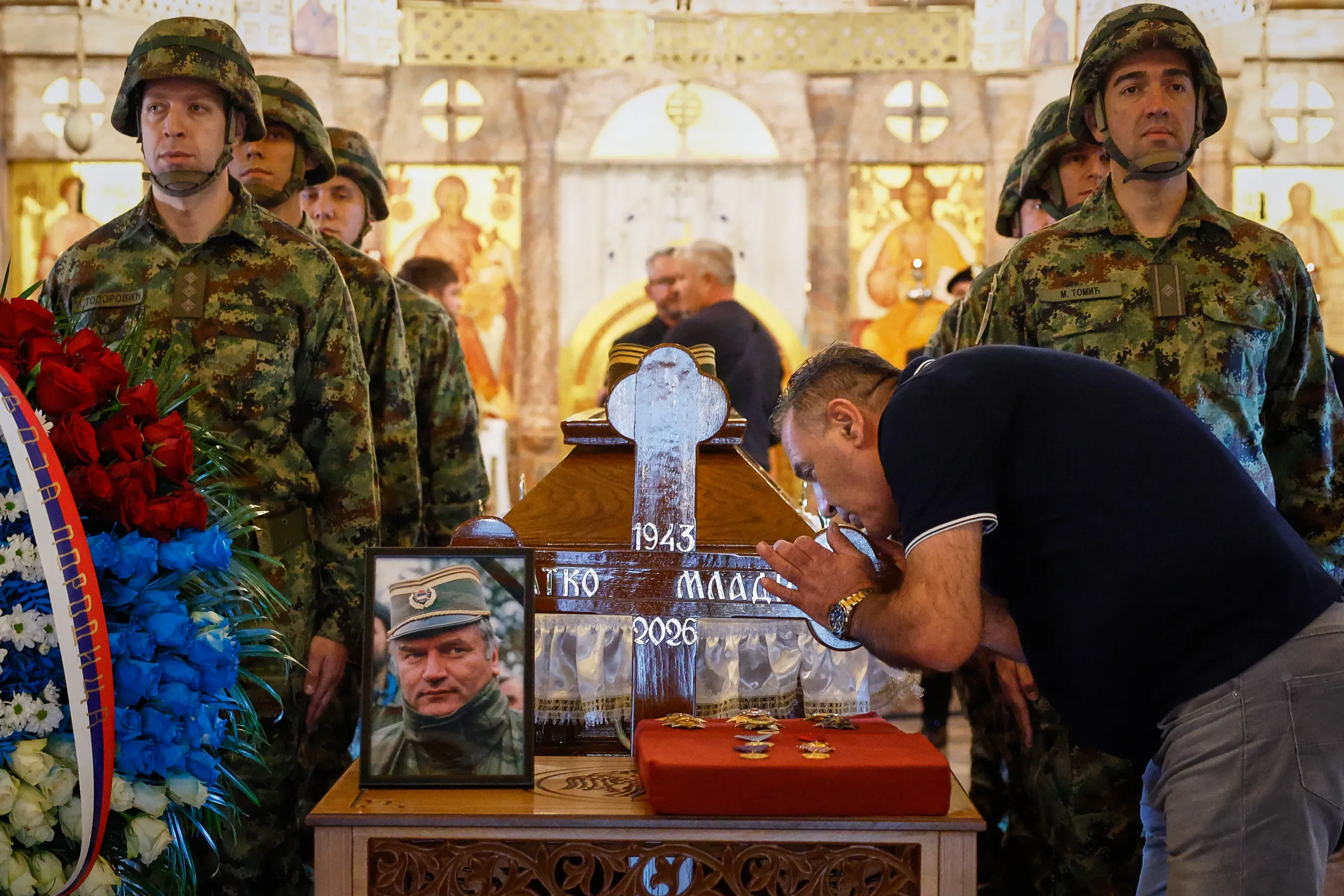
The body of Ratko Mladic, the Bosnian Serb commander who died while serving a life sentence for war crimes, lay in state on Monday as Serbia disregarded European Union warnings against allowing public homage to the man found guilty of the continent’s first case of genocide since World War II.
Thousands of mourners arrived early at the small Serbian Orthodox Church of St. Luke in Belgrade to honor Mladic, who remains viewed as a hero by many Serbs. His military officer’s cap and saber rested on the coffin, which was flanked by men in fatigues.
Pro-government media in Serbia reported that Mladic will receive full military honors while Patriarch Porfirije, the head of the Serbian Orthodox Church, will lead the funeral service.
Milan Dobric, a mourner who traveled from Kosovo for the funeral, stated that Mladic “was a man who gave everything in his life for the Serbian people,” adding, “I am glad that this morning people are coming to pay special respect.”
Mladic died at age 84 on August 27 in The Hague, Netherlands, while serving a life sentence for genocide, war crimes, and crimes against humanity committed by his troops during the Bosnian war from 1992-95.
Although Mladic’s family formally arranged the funeral, the Serbian government sent a plane last week to bring his remains to Belgrade, where soldiers carried his coffin wrapped in the national flag. A military commemoration was held on Saturday at an official Serbian army venue.
Populist President Aleksandar Vucic, a former extreme nationalist who supported Serbia’s expansionist policies during the war, described the funeral as an “emotional outpouring” that “has nothing to do with whether Vucic allowed something or not.”
Serbia is a candidate nation for European Union membership and has faced strong criticism for honoring Mladic after his death.
Marta Kos, the enlargement commissioner for the bloc, canceled an upcoming visit to Serbia in protest, arguing that “the glorification surrounding his death is incompatible with the values on which the EU path is built.”
Serbia, which supported Bosnian Serb forces during the war, remains defiant regarding its wartime role and accuses the West of anti-Serb bias.
Vucic asserted that “we (Serbs) have been persecuted and harassed for 30, 40 years ... always guilty whatever happens,” and added that “people just won’t take it any more.”
Vucic, who is not attending the funeral, has previously accused Kos of “lying.” The Serbian president has increased his anti-Western rhetoric ahead of an early parliamentary election expected next month.
Several other European officials joined the criticism of Serbia, alongside regional leaders and relatives of Mladic’s victims from the Bosnian war. The conflict resulted in over 100,000 deaths and left more than 1 million people homeless before concluding in a U.S.-brokered peace agreement in 1995.
Mladic was sentenced in 2017 for orchestrating the massacre of over 8,000 Muslims in Srebrenica in 1995; he was also convicted for the years-long siege of Sarajevo and other war crimes, including establishing concentration camps for detained non-Serb civilians and enemy soldiers.
Since Mladic’s death, his nationalist admirers have held vigils, painted murals featuring his image in Belgrade, and lit flares in his honor. On Sunday evening, soccer fans displayed a large image of Mladic and chanted his name at a match in Belgrade.
Serbia has refused to acknowledge that genocide occurred in Srebrenica, referring to the massacre instead as a “horrific crime.” Last year, Serbia buried another convicted war criminal, former army chief of staff Nebojsa Pavkovic, with full military honors at a cemetery for distinguished individuals.
The Balkan nation’s EU bid has been stalled due to democratic backsliding and Vucic’s refusal to join international sanctions against Russia over the invasion of Ukraine.
Srebrenica, designated a U.N. “safe haven” for Bosniaks (Bosnian Muslims), was overrun by Serbs who forced men and boys to strip, killed them, and bulldozed their bodies into mass graves. The war began following the breakup of Yugoslavia when ethnic Serbs in Bosnia took control of parts of Bosnian territory to establish their own country and unite it with Serbia.