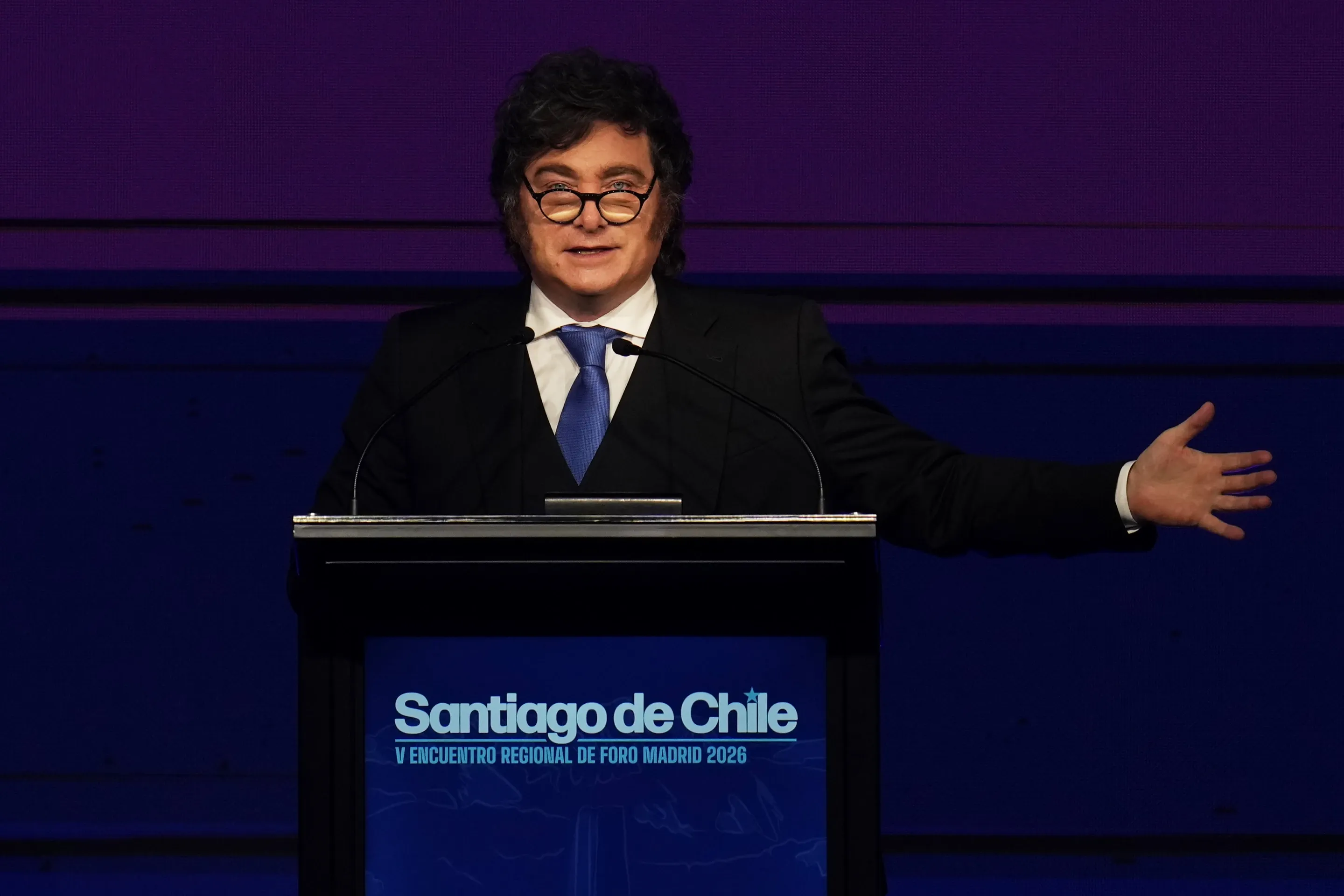
Argentine President Javier Milei escalated his country’s dispute with Britain over the Falkland Islands on Thursday, vowing new measures to halt an oil project near the British-controlled archipelago and commending U.S. President Donald Trump for suggesting Washington might reconsider its neutral stance on the islands’ sovereignty.
Milei presented Trump’s comments as evidence that his close relationship with the U.S. president—which political opponents have criticized as overly deferential—was yielding positive results.
“The United States is considering this change in position because it knows that Argentina has a reliable partner, aligned with Western values, in a strategically important position that can be a valuable ally in the decades to come,” Milei stated during a nationally televised speech.
The Argentine leader subsequently announced extensive actions intended to stop the development of the deep-sea Sea Lion oil project, located about 220 kilometers (140 miles) north of the islands. British company Rockhopper Exploration and Israel’s Navitas Petroleum plan to commence drilling in the coming months, with oil pumping scheduled for 2028. Argentina views this project as an illegal exploitation of resources within waters it claims belong to it.
He threatened stricter sanctions against companies involved in the offshore drilling and announced new funding for a naval base in Tierra del Fuego, Argentina’s southernmost province, to reinforce the nation’s military presence near the islands, referred to as the Malvinas in Argentina.
“Argentina will not stand idly by,” Milei declared. “Any further advance on the Malvinas Islands will be considered a violation of our national security.”
Milei’s attempt to refocus attention on the Falklands represents a notable shift for a leader who has faced domestic criticism for improving ties with Britain and expressing admiration for Margaret Thatcher, the British prime minister whom Argentina detested for leading the campaign to recapture the archipelago during the 1982 Falklands War.
The two-month conflict, which resulted in the deaths of 649 Argentine troops, 255 British service members, and three islanders, remains a contentious issue in Argentina four decades later.
The sovereignty claim is embedded in Argentina’s constitution and frequently cited as an expression of national identity, appearing on banknotes to World Cup soccer chants. It is also one of the few issues that transcends the country's sharp political divisions, providing Milei, who faces re-election next year, a welcome political opening amid declining approval ratings and economic struggles.
“We can argue about my style. We can disagree over fiscal or exchange-rate policy,” Milei said. “But there are causes that rise above any political difference. The Malvinas is one of them.”
Some observers expressed skepticism.
“He wants to use the legitimate sovereignty claim over the Malvinas Islands to regain ground ahead of the election year and serve U.S. interests in its dispute with Britain,” commented Nicolás del Caño, a leftist opposition lawmaker.
Trump Questions US Support for British Sovereignty
Argentina maintains that it inherited sovereignty over the islands from Spain, its former colonizer, and asserts that Britain has illegally occupied them since 1833. Britain refutes this claim, citing the islanders' desire to remain a British overseas territory.
For decades, successive U.S. administrations have maintained neutrality regarding the competing claims while acknowledging Britain’s de facto administration of the islands. Any deviation from this position would constitute a major diplomatic affront and heighten already tense trans-Atlantic relations.
On Monday, Trump generated concern in Britain when asked if his administration was reviewing its stance on the long-standing dispute. “I always review every position,” he responded. “That’s just one of many.”
Subsequently, in an interview aired Thursday with British broadcaster GB News, Trump avoided directly answering a question about whether the U.S. would "come to the aid" of Britain in another Falklands conflict. Instead, he reiterated past grievances that Britain had not provided adequate support for the U.S.-led bombing campaign against Iran.
“Your country was not there to help me,” Trump said, referencing former British prime minister Keir Starmer’s statement that the country lacked ships to contribute to the campaign. “It was pretty sad, the whole thing.”
The Trump administration has previously used the Falklands as leverage: An internal Pentagon email leaked in April first suggested Washington might reconsider its position on the islands as a potential means to penalize NATO allies who declined to join the U.S. war against Iran.
His comments prompted Downing Street to insist that Britain would not relinquish sovereignty over the Falklands.
“Sovereignty rests with the U.K., and the islanders’ right to self-determination is paramount,” stated Tom Wells, spokesman for British Prime Minister Andy Burnham, earlier this week, referencing a 2013 referendum where approximately 4,000 residents of the Falkland Islands voted overwhelmingly in favor of remaining a British overseas territory.
Milei Mobilizes Argentines Around National Flag
Under pressure from Argentina’s populist opposition, which accuses him of neglecting the nation's sovereignty claim, Milei has become more vocal regarding the Falklands as plans for large-scale oil production around the islands increase the economic stakes of the dispute.
In his speech, Milei cautioned that the Sea Lion project could initiate a broader Falklands oil boom, enriching the islands with resources Argentina claims as its own and further solidifying Britain’s presence. There was no immediate reaction from Downing Street on Friday morning.
“If we allow it, we will be creating an incentive for the British government to deepen the occupation of the islands and the exploitation of our resources,” Milei stated.
He pledged to expedite sanctions against companies involved in oil projects near the islands and extend penalties to their suppliers, shareholders, and directors. His proposed legislation could also prohibit companies linked to such projects from operating or signing contracts within Argentina.
Despite cutting public spending elsewhere as part of his austerity measures, Milei also committed more funds to constructing a naval base in Tierra del Fuego and upgrading Argentina’s telecommunications capabilities there to strengthen the country's South Atlantic presence.
“A poor country without armed forces can hardly make effective progress on its sovereignty claims,” he concluded.